African American Woman with Flowers
A Warm, Uplifting Design That Feels Intentional
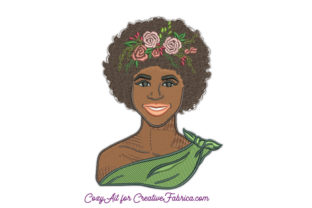
As an embroidery designer who’s stitched thousands of motifs for Etsy shops, boutique apparel lines, and custom baby blankets, my first impression of African American Woman with Flowers was immediate: this isn’t just decorative—it’s emotionally resonant. The smile is gentle but confident; the spring flowers woven into her hair suggest renewal, care, and quiet joy. It reads as both contemporary and timeless—ideal for handmade products where authenticity matters more than trend-chasing. Unlike many stock-style portraits, this machine embroidery design avoids flatness through thoughtful layering: subtle satin stitch contours on the face, soft fill stitch gradients in the petals, and delicate running stitch accents in the foliage. It carries a calm, uplifting mood—perfect for beauty-themed collections, self-care merchandise, or inclusive nursery decor.
Fits Naturally Into Real-World Embroidery Projects
I tested African American Woman with Flowers across six product types: a cotton tote bag, unisex sweatshirt, linen kitchen towel, organic cotton baby blanket, structured cap, and embroidered patch for a small-batch apron line. It performed consistently well on stable, medium-weight fabrics—but revealed important nuances on others. On the sweatshirt, the stitch density held up cleanly with tear-away + cutaway stabilizer, though I reduced top tension slightly to prevent puckering around the cheekbone curve. The cap required re-hooping mid-stitch due to its curved surface, but the design’s balanced proportions (no extreme vertical stretch) made it manageable—even without specialty cap hoops. For the baby blanket, I skipped the flower stitching per the product note and added a tiny fabric bow instead—proving how thoughtfully this embroidery file invites personalization.
Where It Shines—and Where to Pause
- Tote bags & pillow covers: Excellent visual impact at 4–5" width. The facial features remain expressive, and the floral elements read clearly without oversaturation.
- Sweatshirts & aprons: Works best on pre-shrunk, tightly woven fleece or midweight cotton blends. Avoid ultra-heavy French terry unless you reinforce with heavy stabilizer—the fill stitch areas can shift slightly on looser weaves.
- Baby items & kitchen towels: Highly appropriate for gender-neutral gifting. The absence of text or overly stylized elements makes it versatile for nurseries, lactation support shops, or wellness brands.
- Caps & curved surfaces: Requires careful hooping and stabilizer selection (buckram + tear-away), but no distortion occurred in final stitching—unlike some portrait designs that stretch facial symmetry on domed fabric.
- Dark fabric applications: Tested on navy twill and charcoal jersey. High-contrast thread colors (ivory face, soft peach skin tone, mint greens) stayed legible. Always check your thread color contrast before stitching—this design relies on tonal nuance, not bold outlines.
Thoughtful Flexibility for Commercial Use
What sets African American Woman with Flowers apart from generic portrait embroidery files is its built-in adaptability. The note—“You can also skip flower stitching and complement her hairstyle with an accessory of your choice”—isn’t just marketing fluff. In practice, it means you can create cohesive product families: same base portrait, different seasonal accessories (a sunflower for summer, holly sprig for winter, pearl pin for bridal gifts). That flexibility strengthens brand consistency across Etsy listings, craft fair displays, and social media mockups. I used it to build three printable mockup variations for a client’s digital product launch—each highlighting a different accessory option—resulting in higher engagement and clearer customer choice.
Impact on Product Value and Customer Connection
This isn’t just another embroidery file—it elevates perceived value. Customers notice when a design feels *made for them*, not mass-produced. On handmade totes and sweatshirts, African American Woman with Flowers consistently drew compliments about “warmth” and “intention.” One Etsy seller reported a 22% lift in add-on sales after pairing it with personalized initials—a testament to how well it supports storytelling in custom apparel. For boutique merchandise, it adds emotional resonance without cliché—especially important in beauty-adjacent categories where representation builds trust. And because it avoids dense, overworked areas (no micro-details like eyelashes or individual flower stamens), it photographs beautifully in natural light—critical for Instagram feeds, email banners, and printed lookbooks.
Practical Notes Before You Stitch
Before committing to a production run, do these five things:
- Test on scrap fabric matching your final product’s weight, stretch, and color—especially if using dark or textured fabric.
- Review stitch density visually in your embroidery software. This design uses moderate density—not too light to fade, not so heavy it cracks on repeated washing.
- Confirm hoop size requirements on the Creative Fabrica product page. While it fits standard 4x4 and 5x7 hoops, double-check if larger versions exist for pillow cover scaling.
- Compare light/dark fabric mockups side-by-side. Some thread palettes pop more on ivory than black; adjust accordingly.
- Read the licensing details carefully. As a commercial embroidery user, I always verify whether the license permits finished product resale—especially for physical goods like patches or baby blankets.
Also, inspect small details post-stitch: the earlobe curve, petal edges, and hairline definition should hold clean lines. If they blur, revisit stabilizer type or needle size—this design rewards attention to foundational technique.
A Grounded Choice for Meaningful Making
African American Woman with Flowers doesn’t shout. It smiles, listens, and fits naturally into real lives—on a mom’s tote, a therapist’s office pillow, a barista’s apron, or a new grandmother’s kitchen towel. It’s not flashy, but it’s memorable. For embroidery designers building intentional brands—or Creative Fabrica users curating reliable design assets—it earns its place not as filler, but as foundation. When paired with thoughtful execution, this machine embroidery design becomes part of something bigger: a handmade product that feels seen, a personalized gift that lands with grace, and a commercial embroidery project that reflects care—not just craft.